
Search and compare cheap domestic and international flights

Top Cities to Visit in 2026
Book your dream flight easily with our flight aggregation service




















Welcome to TICKETS!
Discover a seamless travel comparison platform on TICKETS. Easily compare flights, prices, and options from multiple providers in one place.
About TICKETSFind Cheap Flights from Your Location
The cheapest flights from your location are automatically determined based on the most popular countries

Warsaw Chopin
Nov 2026
Non-stop
One Way
Dortmund
Nov 2026
From
zł108
Warsaw Modlin
Nov 2026
1+ Stops
One Way
Karlsruhe / Baden-Baden
Nov 2026
From
zł154Warsaw Modlin
Nov 2026
1+ Stops
One Way
Berlin Brandenburg
Nov 2026
From
zł155Warsaw Modlin
Nov 2026
1+ Stops
One Way
Cologne
Nov 2026
From
zł180Warsaw Chopin
Nov 2026
1+ Stops
One Way
Weeze
Nov 2026
From
zł185Warsaw Chopin
Nov 2026
1+ Stops
One Way
Memmingen Allgäu
Nov 2026
From
zł189Warsaw Modlin
Nov 2026
1+ Stops
One Way
Hahn
Nov 2026
From
zł194Warsaw Modlin
Nov 2026
1+ Stops
One Way
Nuremberg
Nov 2026
From
zł233Warsaw Modlin
Nov 2026
1+ Stops
One Way
Munster Osnabruck
Nov 2026
From
zł238Warsaw Chopin
Nov 2026
1+ Stops
One Way
Bremen
Nov 2026
From
zł252Discover Top Destinations: Best Flights by Continent
Travel insights across continents and countries with the cheapest flight prices






Cheap Flights to Cities We Love
Our unbeatable flight deals make your dream trips more affordable than ever


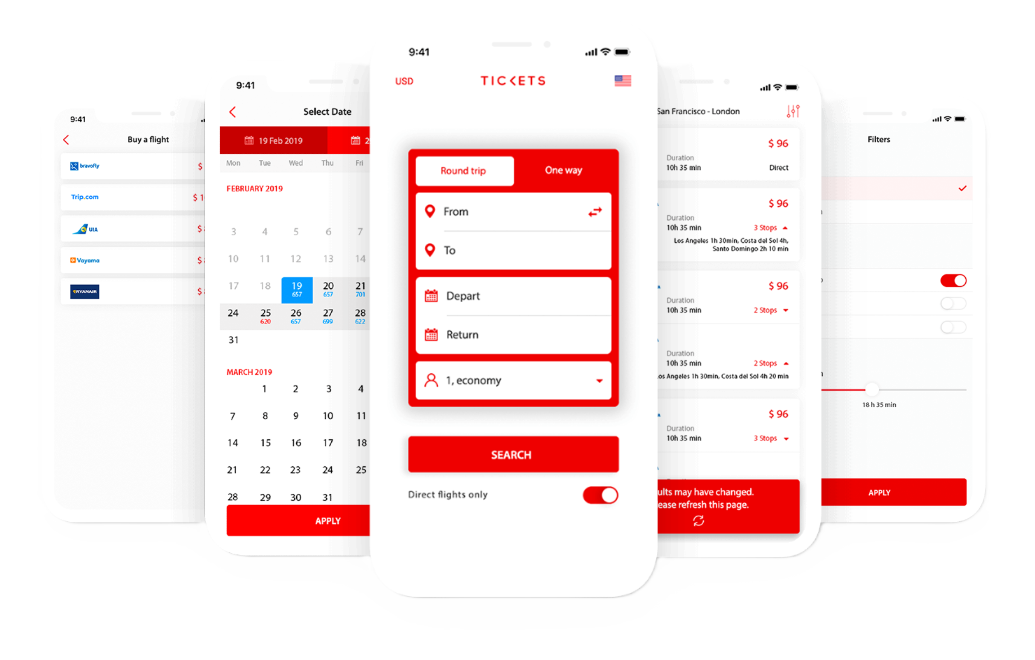
Our TICKETS app for iOS searches through thousands of flight offers from hundreds of airlines and providers, delivering the best global travel deals straight to your hands.
Cheap flights and plane tickets: when to buy at the lowest price and how to avoid overpaying
How far ahead should you book a cheap plane ticket to catch the lowest fare?
To get a cheap plane ticket on short and medium routes, book roughly one to two months before departure, with the sweet spot usually landing around six weeks out. Booking far too early on nearby routes, such as flights from Warsaw across Europe, most often costs more, so the "buy as early as you possibly can" rule is a myth here. Long-haul intercontinental flights need a bigger cushion of several months, and popular destinations in peak season need even more. The price of the same ticket changes many times before takeoff, so hunting for one perfect day is a losing game from the start. It is better to set a price alert and let the TICKETS app send you a notification when the fare moves. The rule that always holds: don't leave the purchase to the last two weeks, because that's when flight prices rise the fastest.
When does the genuinely cheapest moment to buy a plane ticket actually fall?
Buying a ticket the day a route opens — whether from Warsaw or Kraków — feels like beating the rush, yet it's one of the costliest things you can do, because the floor is still weeks away. Ticket prices are high in the very early window, drop to a low around six weeks before departure, and then climb as the plane fills up. Both extremes, the super-early one and the last-minute one, are unfavourable, and the cheapest ticket sits in the middle. The exception is long-haul flights and peak season, where seats genuinely sell out, so booking several months ahead protects both the price and availability. For short off-season trips there's no need to rush; for long or in-demand routes it pays to book early. Instead of guessing which band your route falls into, rely on the "buy now or wait" feature on TICKETS.COM.PL, which analyses around 12 months of price history and tells you whether to grab the ticket right away or hold off.
Which day of the week is cheapest to fly, and is it even worth the bother?
A weekday departure beats a weekend one on price, and Sunday is the day worth skipping altogether. Tuesday and Wednesday usually deliver the lowest ticket price, while Sunday tends to be the most expensive day to fly out. The best day shifts depending on the route and time of year, so treat "mid-week, not Sunday" as a rule of thumb, not a hunt for one magic day. On cheap, short European hops, for example from Warsaw to popular capitals, the saving is small, while on long-haul flights it pays off more, because moving off the weekend can cut the price per person. One distinction matters: it's about the day you fly, not the day you buy the ticket. The old "buy on Tuesday" advice no longer works, because ticket prices now update in real time rather than once a week. To spot cheaper stretches across the calendar, the monthly price view shows you the cheap months, while the mid-week rule handles the day.
Why is a split round trip sometimes cheaper than a single airline's offer?
It comes down to arithmetic: a one-way out on one airline and a one-way back on another can add up to fewer złoty than any single carrier's round-trip offer from Warsaw. On every round-trip search, TICKETS.COM.PL also prices the outbound and return legs separately, then combines the cheapest outbound with the cheapest return into one "mash-up" result. We only show such a two-ticket combination when it genuinely beats the best normal round-trip offer, with the saving shown in PLN. If a standard round-trip ticket ties or wins, that's exactly what you'll see. The catch is that a mash-up is two separate tickets and two confirmations, so before paying you have to open both booking pages. We flag this combination so you know what you're buying, and it only pays off when the difference is real.
Is it better to buy two one-way tickets instead of one round trip?
Two separate one-way tickets can quietly undercut the cheapest round trip, and TICKETS.COM.PL does the digging for you, because every round-trip search already runs that comparison in the background. When the cheapest outbound and the cheapest return fall with different carriers — easy on Warsaw routes where a budget airline flies out and a legacy carrier flies back — two one-way tickets can together cost less than any single round-trip ticket. We combine them into one mash-up result, but show it only when it beats the best standard round-trip offer, with the saving shown in PLN. The trade-off is logistical: a mash-up is two separate plane tickets with two airlines, bought in two separate bookings. You pay for and confirm each leg separately, you get two confirmations and two cancellation deadlines, and you check baggage and change conditions with each carrier individually. For an ordinary there-and-back trip this is usually no problem at all. If you care about a single booking and shared conditions, weigh the saving against that extra hassle.
If my dates are flexible, how much does that really save when hunting for cheap flights?
Of every way to cut a cheap flight, loosening your dates is the one that pays off most, because flexibility lets you stack savings rather than rely on one trick. Shift your departure to mid-week instead of the weekend, then to a cheaper off-season month, and those two things together deliver a real cut to the ticket price versus a peak-and-weekend fare. Choosing a shoulder season alone is the strongest lever: the quieter periods between holiday peaks usually sit well below the height of summer or late December, so a Warsaw–Kraków hop or a Gdańsk run from WAW tends to land cheaper in spring or autumn. Which months are cheapest changes by route, region and hemisphere, but "avoid the obvious peaks" works almost everywhere. Hitting the perfect day of the week, by contrast, gives little on a cheap route. That's why the whole-month view beats checking one date at a time: on TICKETS.COM.PL the calendar shows the indicative lowest price for each month across a multi-month window, so the cheap months stand out at once, priced in złoty.
Is it worth flying from a different airport to buy a cheaper ticket?
Pick a different airport and you can often walk away with a cheaper ticket — occasionally far cheaper — since budget airlines gather at smaller fields where lower fees translate immediately into the price in złoty. Around Warsaw this is easy to see: budget connections often leave from Modlin (WMI), while Chopin Airport (WAW) handles most of the traditional carriers' network. The catch is the door-to-door cost. A cheaper ticket from an out-of-the-way airport only wins once you add parking, transport and the extra time needed to get there, and Modlin is farther from central Warsaw than Chopin. TICKETS.COM.PL detects the airport nearest to you, and you can also set your home airport manually. There is no automatic radius search that gathers nearby airports into a single query, so to check that second one you set it as your starting point and compare. A faster way to scan prices from your area across many destinations is the destination map. The takeaway: compare the total trip cost, not just the headline price.
Is a cheaper flight with a self-transfer worth the risk of missing the second leg?
The złoty you save on a self-transfer fare from Warsaw or Kraków buys you a hidden job: insuring the trip yourself. So-called virtual interlining stitches two separate tickets, often with unrelated airlines, into one journey, and the carriers have no agreement protecting that connection. The real risk is the transfer. If the first leg is delayed and you miss the second, that airline owes you nothing, you're the person who didn't show up, and you may have to buy a new ticket. You collect and re-check your baggage between legs yourself, and any compensation is counted separately for each ticket. So price in the worst case, not the headline fare: leave a generous layover, a few hours with carry-on and more with checked baggage or an airport change, and consider insurance for a delay. TICKETS.COM.PL shows these cheap self-transfer flights together with a warning, and the route map marks every airport change, so you decide fully informed.
Do price alerts on plane tickets really help, or are they just noise?
Whether a fare out of Warsaw is about to fall isn't something an alert foresees — it simply catches the drop and tells you. A flight's price moves many times before takeoff, so a price alert in the TICKETS app watches your chosen route and sends you a push notification the moment the fare actually drops, turning the timing question from a guessing game into a simple rule. You set the alert, then buy in a cheap window or at a genuine low. Alerts deliver the most when your dates are flexible, you're booking well ahead, or you're tracking long-haul routes, which swing the most. The blind spot: a lightning-fast deal can vanish before the alert even fires. If you'd rather have a trend than a single signal, the "buy now or wait" feature reads roughly a year of price history as buy, wait or neutral. Price alerts in the TICKETS app are free.
Will this ticket's price drop, or is it better to buy it right now?
Stop refreshing and ask the data instead: set today's price for a route out of Warsaw beside that route's own 12 months of history, and the "buy now or wait" feature on TICKETS.COM.PL does precisely that comparison for you. You give it a route and get one of three verdicts, buy now, wait or neutral, each with a confidence level, the cheapest and most expensive months, and whether the trend is rising, falling or steady. The rule that holds up against the data: in the cheap window (roughly six weeks before departure on short routes, several months on long-haul) and at or below the level typical for the route, buy. Early in the cycle, when prices are high for the season, waiting can pay off. The strongest signal is the simplest: don't leave the ticket purchase to the last two weeks, because that's when prices rise the fastest. Still not sure? Set a price alert and let the price changes settle the decision.
If comparing flights is free with no markups, how does TICKETS.COM.PL make money?
Short answer: the airline or agency pays us, you don't. TICKETS.COM.PL collects a referral commission from the seller, and only once your booking is complete. The ticket price you see is the airline's or travel agency's own fare, shown as is, with no markups. You click to book a flight out of Warsaw Chopin, we redirect you to that provider's site where you pay in złoty, and the provider pays us a referral commission. That commission doesn't affect the price you see and pay, so comparing cheap flights, the monthly price view, the destination map and the "buy now or wait" feature are all free, as are route price alerts in the TICKETS app. We earn solely on a completed booking, with no subscription, no booking fee, and no surcharges tacked onto the ticket price.
In which month of the year are the cheapest plane tickets bought?
You'll buy the cheapest plane tickets by flying in the shoulder seasons between holiday peaks, because this one choice beats any day-of-the-week trick. On many markets the price lows fall in January and February (after the winter break) and again in September and October (once the summer crowds are gone). The expensive windows are the height of summer (roughly June to August) and the year-end holiday period. It varies by route, region and hemisphere, since summer in the southern hemisphere or a local holiday can flip it, but "avoid the obvious holiday and summer peaks" works almost everywhere. On TICKETS.COM.PL you can preview price data for destinations, showing the cheapest and most expensive months across a 12-month span, so the cheaper stretches are easy to spot, and then search flights on the results page to see currently available prices.